

Understanding how demand for adult social care will change over time is essential for effective policy reform. Decisions about funding, workforce planning and service design all depend on having a credible sense of how many people may need support in the future – and when.
In our new discussion paper, we explore whether Scotland can replicate the long‑term care projection models used in England and Wales, and what can be learned from doing so. We also present an initial, pragmatic approach to projecting the number of older people who may draw on adult social care services in Scotland under current eligibility rules.
Whilst our results are informative, they also highlight significant gaps in Scotland’s data landscape that limit what can be concluded with confidence.
Why modelling social care demand matters now
This work sits squarely within the context of ongoing social care reform in Scotland. Although plans for a National Care Service were not taken forward, the Care Reform (Scotland) Act (2025) sets new requirements for the Scottish Government to publish projections of future social care need, beginning in 2026 and updated every five years.
Long‑term projections matter because social care demand evolves over decades, not within spending review periods. Without a credible understanding of forward pressures, policy risks being reactive rather than anticipatory – particularly as Scotland’s population continues to age.
Learning from England and Wales: the CPEC model
In England and Wales, the Care Policy Evaluation Centre (CPEC), based at the London School of Economics, maintains a well‑established long‑term care projections model. This is a macro‑simulation model that estimates:
- The number of older people with different levels of disability
- Demand for unpaid and formal care
- Associated public and private expenditure
- Workforce requirements (in extended versions).
Crucially, this is a projection model, not a forecast: it shows what would happen if certain trends and assumptions were to hold, rather than predicting what will happen.
Our first objective was to assess whether this model could be replicated for Scotland.
Can the CPEC model be replicated in Scotland?
The short answer is: not in full – at least not yet.
Scotland has access to a wide range of relevant data across population projections, health surveys and social care usage. However, these data are not currently aligned, detailed, or integrated enough to robustly replicate all four stages of the CPEC model.
Key challenges include:
- Disability data: Limited sample sizes make it difficult to estimate disability rates by age, gender, household type and other characteristics simultaneously. Different surveys also measure disability in different ways, producing very different prevalence rates.
- Care usage modelling: Scotland benefits from strong administrative data on who currently receives social care, particularly through Public Health Scotland. However, the behavioural modelling used in England to estimate probabilities of care receipt cannot be replicated in the same way given data constraints.
- Cost and expenditure data: Perhaps the most significant gap is the lack of a robust, agreed approach to estimating unit costs of social care services in Scotland – a prerequisite for expenditure modelling.
The issue is not a total absence of data, but a mismatch between what projection models require and how existing data are collected, linked and maintained.
A pragmatic alternative: projecting the number of service users
Although full replication is not currently feasible, our research demonstrates that more limited – but still useful – projection work is possible.
The second part of the paper sets out an exploratory model to project the number of older people (65+) likely to draw on adult social care services in Scotland under current eligibility rules.
This approach focuses on met need – that is, people who draw on formal care services, rather than the wider group of people needing care who may draw on them under different circumstances. The modelling also focuses on the number of service users rather than the fiscal cost of service provision.
The model combines three main data sources:
- National Records of Scotland population projections (2022‑based)
- Understanding Society and Family Resources Survey data, to estimate disability prevalence by age and gender
- Public Health Scotland Insights on Social Care, to identify current service usage
Rather than estimating behaviour from scratch, we calibrate the model to a 2022 base year, for which the number of service users is known, and project forward by allowing demographic change to drive future demand.
What do the projections show?
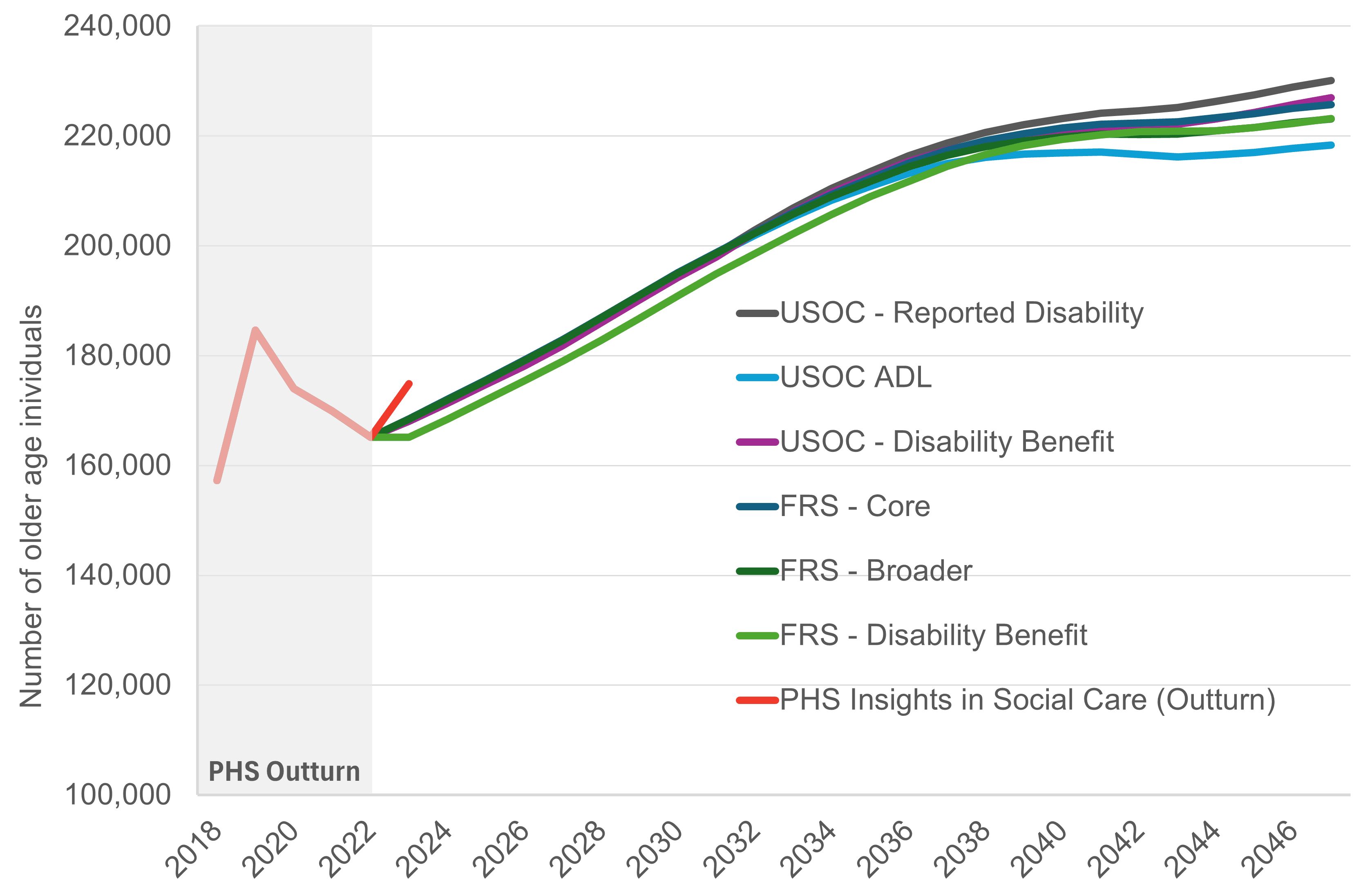
Despite outturn data suggesting a slight fall in the number of older people receiving social care since 2019, our projections indicate that demand rises steadily over the long term.
Under our highest projection:
- The number of older people drawing on adult social care services increases to around 230,000 by 2047
- This represents an increase of approximately 39% compared to 2022 outturn data, where the number of users was under 170,000.
Chart: Projected number of older age adult social care users in Scotland (2022-2047)
Source: FAI Calculations, Understanding Society Waves 9 – 13, Family Resources Survey 2021-2023, National Records for Scotland 2022
The rise is driven by population ageing, which increases the number of people at ages where disability is more common. The model then assumes a constant relationship between the prevalence of disability and the usage of care services.
Importantly, different ways of measuring disability led to different estimates of overall demand levels. However, because results are calibrated to 2022, it is the age‑gender pattern of disability, rather than its absolute prevalence, that most influences the projected trend. Ultimately, the different measures of disability that we tested all paint a similar picture of future levels of service demand.
How confident should we be?
These projections should be treated with caution.
They rely on strong assumptions, exclude unmet need, and reflect current eligibility and service patterns rather than policy change. They are not official forecasts.
That said, two points are reassuring:
- The projections align closely with recent Public Health Scotland outturn data in years where both are available.
- They demonstrate that it is possible to model future demand in a transparent way using existing Scottish data – even if imperfectly.
As such, the value of this work lies less in the precise numbers and more in showing what is feasible now, where the limits are, and what would need to improve.
What have we learned?
Three broad lessons emerge:
- Measuring disability consistently is fundamental. Without better, more granular data on disability by key characteristics, models of this kind will remain constrained.
- Demand modelling is more straightforward than cost modelling. Whilst existing sources can be used to project how many people will need care, how much that care will cost raise several additional questions.
- Data integration matters as much as the data itself. Many of the required datasets exist, but are siloed, published with long lags, or designed for reporting rather than modelling.
Where next?
This paper is not an endpoint, but a starting point. Improving social care projection modelling in Scotland will require:
- Investment in more consistent, linkable social care and disability data
- Development of agreed approaches to estimating unit costs
- Clearer articulation of how projections will be used in policy decisions.
Encouragingly, recent moves to bring social care data into Scotland’s national safe haven offer significant potential to strengthen future work.
For now, this research shows that while Scotland cannot yet fully replicate the sophisticated models used elsewhere, there is scope for meaningful, incremental progress – and that progress is essential if social care reform is to be grounded in robust evidence.
You can read the full discussion paper here.
Authors

Ben is an Economist Fellow at the Fraser of Allander Institute working across a number of projects areas. He has a Masters in Economics from the University of Edinburgh, and a degree in Economics from the University of Strathclyde.
His expertise lies in various economic modelling approaches, social care, and evaluating social impact for organisations across the private, public and third sector, particularly where evaluation requires intuitive approaches.

Spencer is a Senior Knowledge Exchange Fellow at the Fraser of Allander Institute.