

Poverty is a key determinant of health inequalities, but can itself be driven by a range of factors. A new report published by the Scottish Health Equity Research Unit (SHERU) compares poverty rates in Scotland and the rest of the UK, investigating the differences between them and how they have changed over time.
The overall poverty rate – defined as the proportion of people living in households that have less than 60% of average UK household income, after housing costs have been subtracted – has been lower in Scotland than in the rest of the UK as a whole (rUK) since the early 2000s. We know from previous work conducted by the Joseph Rowntree Foundation that this divergence was driven by differences in housing costs, with higher social rents in England meaning that poverty reductions observed in Scotland were not mirrored in rUK.
The divergence continued to widen up until 2010s. But from that point on, it began to reverse: the poverty rate began to rise in Scotland while staying relatively static in rUK. Since 2019-22, the difference in poverty rates between the two areas – which, of course, conceal important differences at lower geographical levels – has only been one or two percentage points. At the same time, the survey sample on which the data is based has shrunk to less than half of its previous size.
The smaller the sample, the greater the random variation that is intrinsic to this kind of survey data. And the smaller the difference in poverty rates, the more difficult it is to distinguish from that variation. As a result of both factors, the difference in poverty rates between Scotland and rUK has not been statistically significant since 2019-22, meaning we cannot be confident that it is systematically present in the data. The latest period of data does however show possible signs of a further divergence, reflecting the roll-out of the Scottish Child Payment.
Percentage of people in relative poverty after housing costs, three-year average
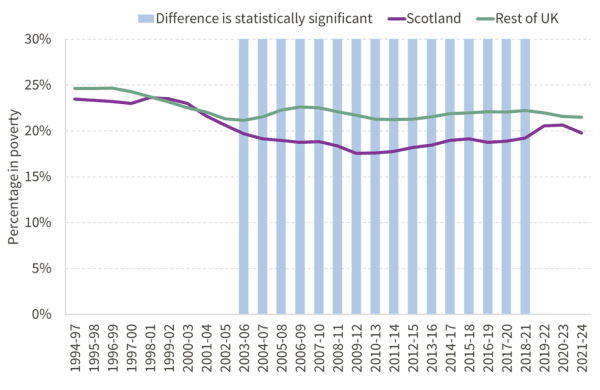
Notes: Based on the methodology outlined by DWP, 2025, Measuring Uncertainty in HBAI Estimates. Significance Relative poverty defined as having net equivalised household income below 60% of the UK median. Significance measured at 5% level. Data for 2020-21 has been excluded owing to data quality issues.
Source: FAI analysis of DWP, Households Below Average Income
The report goes on to investigate the factors underlying the convergence in poverty rates between Scotland and rUK. The first finding is that, in contrast to the divergence of the 2000s, the convergence of the 2010s appears to have been driven by income rather than housing costs. Breaking down the convergence by family type, economic status, and housing tenure, the results also point to changes in the risk of living in poverty, rather than changes in the makeup of population.
Single adults without children, households receiving Universal Credit where at least one adult is in work but not all are working full time, and social renters accounted for particularly large shares of the convergence. But the big picture is that the convergence was broad-based: across all three sets of characteristics, most groups experienced increases in poverty risk between the two time periods, and most of these increases were larger in Scotland than they were in rUK. Further research is therefore needed to pinpoint the factors behind the convergence, whether they are related to welfare reform, wage stagnation, or other influences that were present in the 2010s.
The broad-based nature of the convergence also raises questions for policy. Child poverty has been a key focus of the Scottish Government since the enactment of statutory targets in 2017. It is important that this focus – which is justified – does not come at the cost of neglecting other groups that may be struggling. The National Performance Framework did include the overall poverty rate as an indicator, but is currently paused, with no strategy in place to address poverty among population groups other than families with children.
For its part, SHERU will soon be publishing analysis focusing on poverty among young adult men. Particular sections of this demographic face inordinately high risks of experiencing early, preventable deaths, but are generally overlooked when it comes to addressing the drivers of health inequalities. The analysis will go some way towards filling this gap.
Read the new report here.
Authors

Spencer is a Senior Knowledge Exchange Fellow at the Fraser of Allander Institute.