

The Scottish hospitality sector is an important part of the Scottish economy, supporting £1.9 billion of economic activity and 243,000 workforce jobs in Q2 2025.
The second quarter of 2025 showed growth in the Scottish hospitality sector, with increases in both economic activity and employment, and a decrease in the number of vacancies. Revised GDP figures indicate that since 2022 the sector has shown stronger overall growth than the wider economy, and output now sits comfortably above pre-pandemic levels.
Hospitality is the 3rd largest employer in Scotland and has continued its post-pandemic recovery, but still faces some challenges. Employment growth is increasingly driven by part-time roles, now at record levels, and vacancies – while falling – remain above pre-2020 levels, suggesting continued recruitment challenges.
While hospitality pay has risen, now just above the standard low-pay threshold of two-thirds of the national median, pay levels remain far below those seen in other sectors and pay progression is limited.
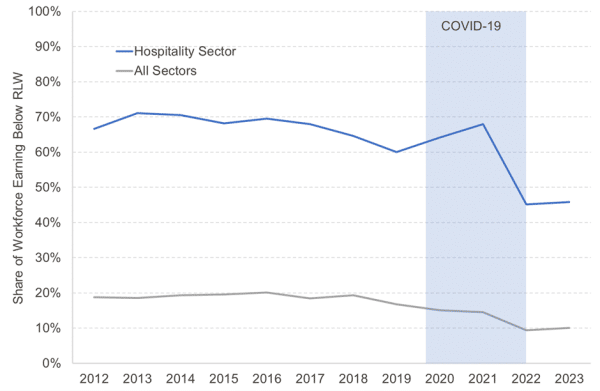
Coupled with 46% of the hospitality workforce who did not receive the real living wage in 2023, these statistics emphasize the significant challenges facing the sector.
This data briefing aims to provide an overview of the latest data associated with the hospitality sector in Scotland, encompassing the latest statistics on economic activity, employment, wages, and poverty.
Economic Activity (GDP)
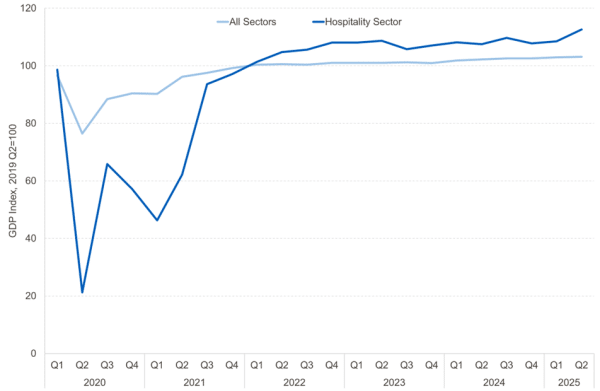
In Q2 of 2025, economic output in the Scottish hospitality sector increased by 3.8%. When compared to growth of 0.2% across the wider Scottish economy, the latest figures indicate that hospitality grew at a faster rate than the economy as a whole during this period.
Revised quarterly GDP data also shows that, since 2022, the hospitality sector has experienced stronger overall growth than the wider Scottish economy as it recovered from the significant decline seen during the pandemic. The hospitality sector’s economic output now sits comfortably above pre-pandemic levels, according to this latest data.
However, growth within the sector has not been consistent, quarterly output has shown a stop-start pattern, indicating that while the trend is upwards, progress remains uneven.
Chart 1: Economic Output in the Scottish Hospitality Sector, Seasonally Adjusted, Q1 2020-Q2 2025
Source: Scottish Government, 2024
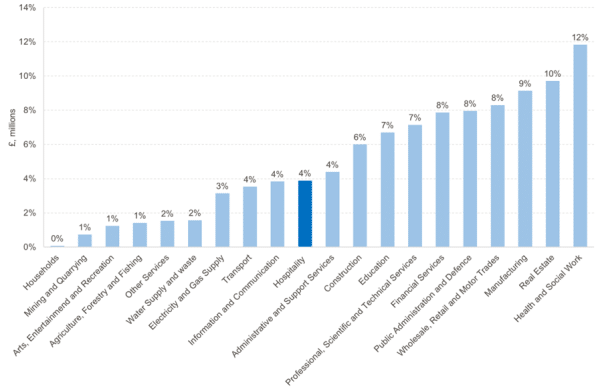
During Q2 of 2025, the Scottish hospitality sector’s Gross Value Added (GVA) (which can be thought of much like Gross Domestic Product (GDP)) was £1.9 billion, accounting for 4% of all Scottish GVA generated in Scotland.
GVA measures the value an industry adds to the economy. It shows how much money a sector contributes after subtracting the costs of the goods and services it needs to operate. In simple terms, it tells us how much of the final economic value is created by that sector.
For example: if a restaurant charges a customer £50 for a meal, but the ingredients, utilities and other inputs cost £30, then the restaurant has added £20 of value. That £20 is the GVA. When we add that up across thousands of hospitality businesses in Scotland, we get the total GVA for the sector.
Compared to other parts of the Scottish economy, the Scottish hospitality sector supported less economic activity than the construction sector or education sector, but more than the electricity and gas sector and the agriculture, forestry, and fishing sector.
Chart 2: Gross Value Added (GVA) by Sector of the Scottish Economy, Scotland Onshore, Q2 2025
Source: Scottish Government, 2025
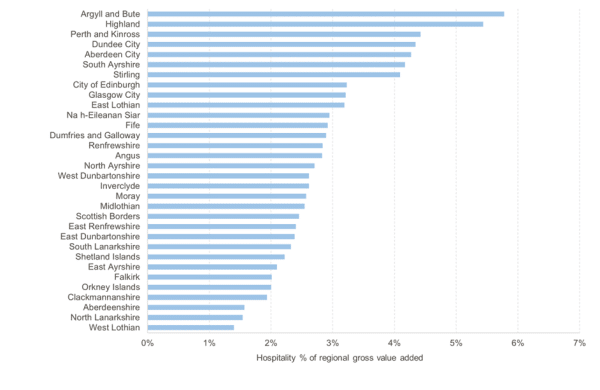
Looking at more local data, hospitality’s importance to different regions varies across Scotland. The sector is especially important to the Highlands and Islands, accounting for 5.8% of GVA in Argyll and Bute and 5.4% in the Highlands during 2022.
The hospitality sector is also important to GVA in Scotland’s cities, most prominently in Dundee (4.3%) and Aberdeen (4.3%).
Chart 3: Hospitality sector as a % of regional gross value added, balanced, based on current prices, Scotland, 2023
Source: ONS, 2025
Employment
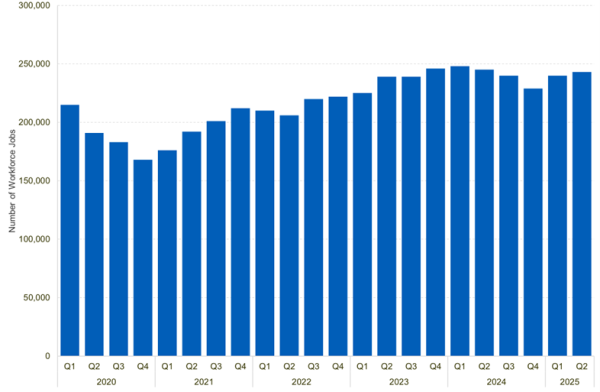
Workforce jobs in the Scottish hospitality sector increased slightly in Q2 of 2025.Between Q1 and Q2 2025, employment rose from 240,000 to 243,000, an increase of around 3,000 workforce jobs.
Following the major drop during the pandemic, when employment fell from 215,000 in Q1 2020 to 168,000 by Q4 2020, the sector has steadily rebuilt its workforce. Employment recovered through 2021 and 2022, rising to 222,000 by the end of 2022, and continued to grow throughout 2023, peaking at 248,000 in Q1 2024.
However, employment has been more volatile over the past year. After Q1 2024, the sector saw a decline across the remainder of the year, reaching 229,000 in Q4 2024, before beginning to recover again in 2025.
Despite these fluctuations, overall employment levels in the hospitality sector remain well above pandemic levels, demonstrating the sector’s role as a significant employer in Scotland.
Chart 4: Workforce Jobs in the Scottish Hospitality Sector, Seasonally Adjusted, Q1 2020 – Q2 2025
Note: Workforce jobs measure the sum of employee jobs, self-employed jobs, government supported trainee’s and jobs associated with the British Armed Forces.
Source: ONS, 2025
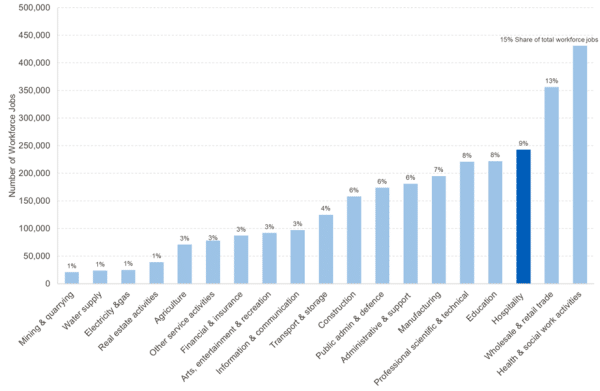
Compared to other sectors of the Scottish economy, the hospitality sector provides the 3rd highest number of workforce jobs, equivalent to 9% of all workforce jobs across Scotland – slightly higher than our last briefing.
This means the Scottish hospitality sector provided more employment than the manufacturing or education sector, but less than the wholesale & retail trade or health and social care sector.
Chart 5: Workforce Jobs across Sectors of the Scottish Economy, Seasonally Adjusted, Q2 2025
Note: Workforce jobs measure the sum of employee jobs, self-employed jobs, government supported trainee’s and jobs associated with the British Armed Forces.
Source: ONS, 2025
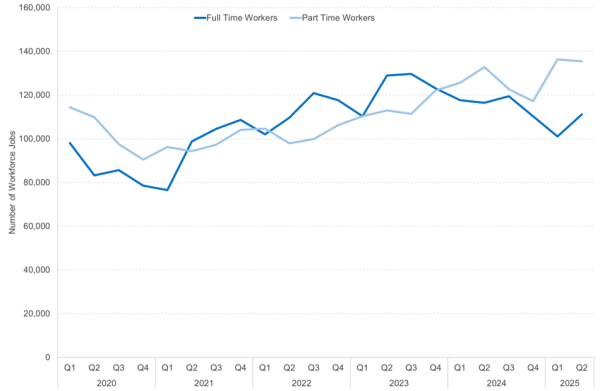
Across all sectors of the Scottish economy, the hospitality sector continues to have one of the highest shares of part-time workers as a share of the total workforce.
In Q2 of 2025, there were 111,117 full-time roles and 135,444 part-time roles in the Scottish hospitality sector. This means that part-time roles made up over half of all hospitality jobs, continuing the trend of part-time work representing the majority of employment in the sector.
Since Q3 2023, there has been decline in the number of full-time roles in the Scottish hospitality sector. At the same time, the number of part-time roles has risen sharply – meaning that part-time roles in Scottish hospitality are now at the highest number ever. This likely reflects the sector’s continued reliance on flexible staffing patterns and cost pressures that make part-time hiring more common.
Chart 6: Number of Part-Time and Full-Time Workforce Jobs in the Scottish Hospitality Sector, Seasonally Adjusted, Q1 2020 – Q2 2025
Source: Nomis, 2025
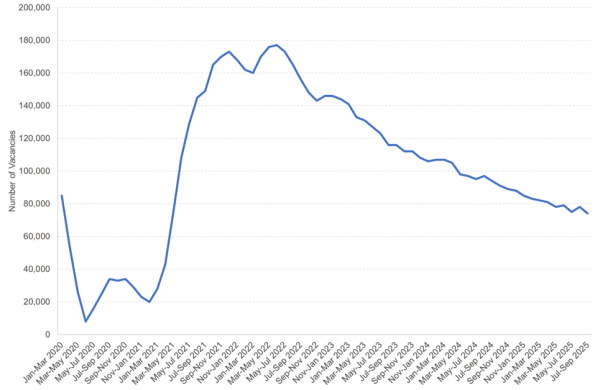
Unfortunately, vacancy data is not available for the Scottish hospitality sector. However, UK-wide data is available. Vacancies in the UK hospitality sector continued to fall throughout 2024 and into 2025. Between July and September 2025, there were 74,000 unfilled roles, marking the lowest vacancy level since early 2021.
This represents a significant change from the peak period in 2022, when vacancies reached record highs. Since late 2022, vacancy numbers have steadily declined.
However, compared to pre-pandemic levels, vacancies in the UK hospitality sector are still 13% higher than they were between January and March 2020, indicating that some recruitment challenges persist.
Chart 7: Number of Vacancies in the UK Hospitality Sector, Seasonally Adjusted, Jan-Mar 2020 to Jul-Sep 2024
Source: ONS, 2025
Earnings
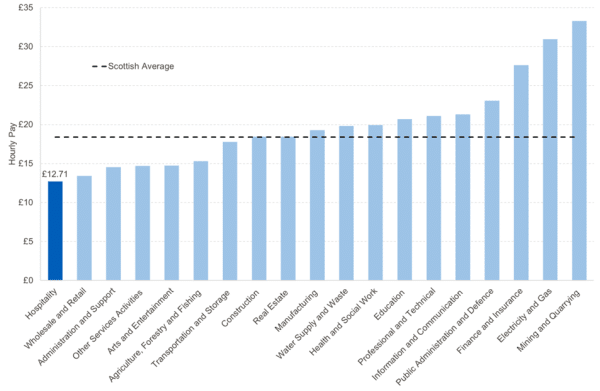
The latest earnings data shows that hospitality continues to be the lowest-paid sector in Scotland.
In 2025, the median hourly wage in the Scottish hospitality sector was £12.71, compared with the Scottish economy-wide median of £18.39 per hour.
While hospitality remains at the bottom of the pay distribution, the latest data shows that median wages in the sector are now slightly above the commonly used low-pay benchmark – less than two-thirds of the average. Two-thirds of the Scottish median (£18.39) is approximately £12.13, meaning hospitality at £12.71 sits just above this threshold. Even so, the sector continues to be characterised by comparatively lowest earnings in Scotland.
Chart 8: Nominal Median Hourly Pay across Sectors of the Scottish Economy, All Employees, 2024
Source: ONS, 2025
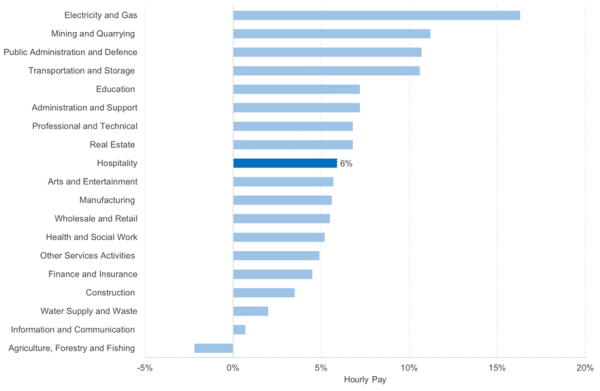
Between April 2023 and April 2024, median hourly pay in the Scottish hospitality sector increased by 5.9%. This represents continued wage growth following the strong increases seen in the previous year, reflecting ongoing recruitment challenges and upward pressure on pay at the lower end of the labour market.
Wage growth in the hospitality sector was slightly higher than average wage growth across the Scottish economy as a whole, which was 5.0% between April 2023 and April 2024.
Compared to other sectors of the Scottish economy, hospitality sits mid-range for annual wage growth. Several sectors experienced similar increases, including wholesale and retail (6%), manufacturing (6%), and arts and entertainment (6%).
Chart 9: Annual Change in Nominal Median Hourly Pay across Sectors of the Scottish Economy, April 2023 – April 2024
Source: ONS, 2025
When evaluating earnings in a particular industry, it is often useful to compare rates of pay against the Real Living Wage, which stood at £12.60 in 2024.
Despite recent wage increases, a significant proportion of workers in Scotland’s hospitality sector continue to earn below the Real Living Wage.
In 2024, 46% of workers in the hospitality sector were paid less than the Real Living Wage, compared to 11% across all sectors in Scotland. This means that hospitality workers are over four times more likely to be paid below the Real Living Wage than the average Scottish worker.
While this represents a notable improvement compared to the years immediately before and during the pandemic, progress has begun to stall since 2022.
Across the wider Scottish economy, the proportion of the workforce earning below the Real Living Wage has steadily decreased over time, from 19% in 2012 to 11% in 2024.
Chart 11: Share of Workforce Earning Below the Real Living Wage, Scotland, 2012-2024
Source: Scottish Government, 2024
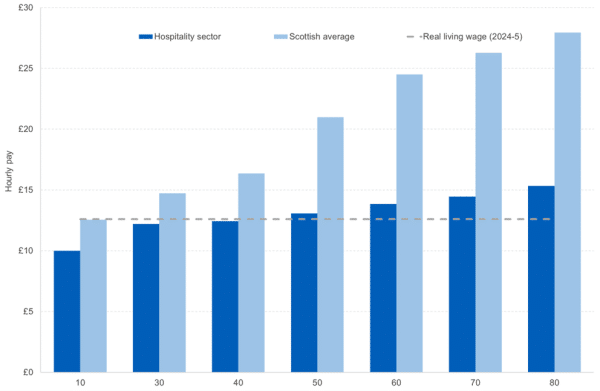
Similarly, the wage distribution across the Scottish hospitality sector can be compared to the Scottish average, and the Real Living Wage.
Employees in the top available wage decile (80th) of the hospitality sector, meaning some of the highest earners, receive an average hourly wage of £15.33. This is considerably lower than the same decile of the Scottish average, at £35.26, showing the limited earning potential within the Scottish hospitality sector.
Chart 12: Wage percentiles of the Scottish Hospitality sector, hourly pay and real living wage, 2024
Note: 20th and 90th Decile not available for Hospitality sector
Source: ONS, 2025
Disclaimer:
Using Standard Industry Classification (SIC) codes, we classify the hospitality sector under industry I: food and accommodation services. This covers restaurants, cafes, pubs, bars, catering, hotels, campsites and other accommodation. The arts, recreation and entertainment sector (industry R) may also be considered part of hospitality, but for simplicity, we will refer only to industry I in this analysis.
About Serving the Future
Serving the Future is a four-year action research project working with hospitality employers and workers. The project is seeking to understand, reduce and prevent in-work poverty and identify changes that could be made within the sector. By working directly with employers and people with experience of low-paid work, the project is taking a variety of approaches to identify changes that can take place at an organisational level as well as necessary policy or systems wide changes that are required across Scotland.
Serving the Future is funded by The Robertson Trust and is being delivered by the Fraser of Allander Institute and the Poverty Alliance.
Authors

Brodie is a Knowledge Exchange Associate at the Fraser of Allander Institute.

Chirsty is a Knowledge Exchange Associate at the Fraser of Allander Institute where she primarily works on projects related to employment and inequality.