

This is the final instalment of our 2026 Election Analysis series, reflecting on the result of the Scottish Parliamentary Election and the start of the Parliamentary Session. We would like to thank colleagues at the Wales Governance Centre who collaborated with us throughout, and the Nuffield Foundation for its generous support – although of course all opinions expressed are those of the authors and may not reflect those of the Nuffield Foundation.
———————————————————————–
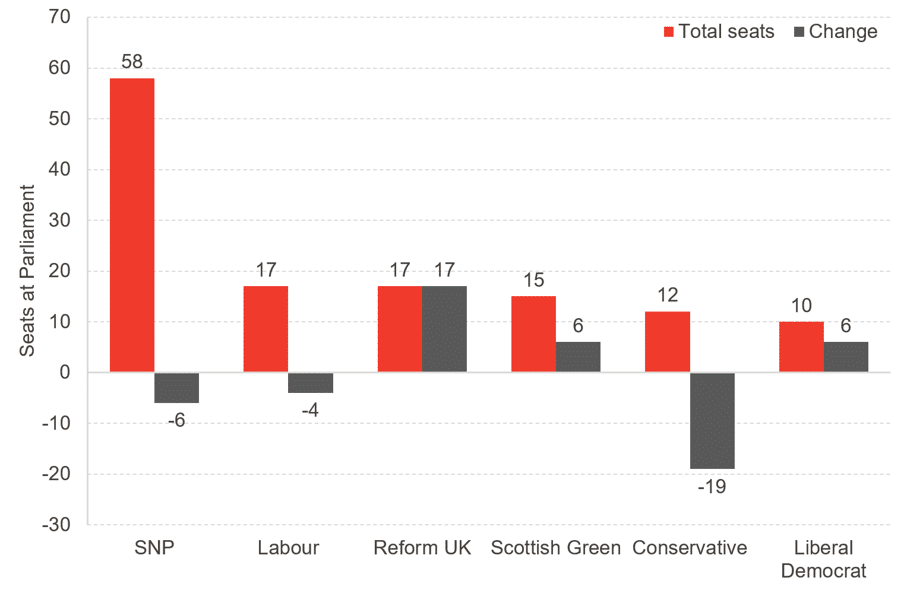
The Scottish Parliament election produced a familiar headline result, with the SNP remaining by far the largest party at Holyrood. Beneath this continuity, however, the election delivered a significant reshaping of the opposition benches, with substantial gains for Reform UK and losses for the Conservatives, altering the balance of political representation across the Parliament.
Source: BBC, FAI analysis
Despite losing six seats, the SNP retained a dominant position with 58 seats, remaining comfortably ahead of all other parties and preserving its status as the central force in Scottish politics. Labour also experienced a modest decline, losing four seats to finish with 17. Together, these results suggest that while support for the two largest centre-left parties softened somewhat, neither experienced a collapse in representation.
The most notable development was the emergence of Reform UK, which secured 17 seats and entered Holyrood on an equal footing with Labour in terms of parliamentary representation. This gain appears to have come largely at the expense of the Conservatives, who suffered the largest losses of any party, falling 19 seats to just 12. The result points to a substantial reconfiguration of the right-of-centre vote in Scotland, with Reform UK replacing the Conservatives as the principal challenger to the SNP from that side of the political spectrum.
Elsewhere, the Scottish Greens and Liberal Democrats both increased their representation, gaining six seats each. These gains, combined with the SNP’s continued dominance, mean that pro-devolution and centre-left parties continue to account for a large majority of seats in Parliament, despite the changing composition of the opposition. Overall, the election suggests continuity in the overall balance of power, but significant change in how opposition to the SNP is represented at Holyrood.
The Aftermath: What Next for Scotland?
While the SNP once again emerged as the largest party in the Scottish Parliament, the election has nonetheless altered the political landscape in important ways. With 58 seats, the SNP remains seven seats short of an overall majority and faces a Parliament in which five opposition parties have secured double-digit representation. As a result, the next parliamentary term is likely to be characterised by greater negotiation and cooperation across party lines than has been required under majority government.
Shifting dynamics in Holyrood
The election reinforced a broader trend towards political fragmentation. Alongside the SNP’s continued dominance, Reform UK recorded a significant breakthrough, while the Scottish Greens and Liberal Democrats also increased their representation. Against a backdrop of declining support for both Labour and the Conservatives, these results suggest that
smaller parties may play a more influential role in parliamentary proceedings over the coming session.
Several notable dynamics have emerged from the result. Reform UK’s gains appear to have come largely at the expense of the Conservatives, reshaping the balance of the centre-right vote in Scotland. Meanwhile, the strengthened position of the Liberal Democrats and Scottish Greens provides both parties with greater visibility and influence within Parliament. The Greens’ performance is particularly noteworthy given the limited number of constituencies they contested, raising questions about their potential role in future elections and the extent to which they can continue to broaden their electoral appeal.
Perhaps the most significant implication of the election concerns the practical operation of government. In the absence of a parliamentary majority, the SNP will need to secure support from other parties to advance legislation and pass budgets. While cooperation with Reform UK or the Conservatives appears unlikely, there may be greater scope for agreement with Labour, the Scottish Greens and the Liberal Democrats on specific policy areas. Both Scottish Greens co-leader Ross Greer and Scottish Liberal Democrat leader Alex Cole-Hamilton have signalled a willingness to work with the SNP on certain issues, providing John Swinney with a number of potential avenues for securing parliamentary support.
For the SNP, the challenge, therefore, will be to build issue-by-issue coalitions while maintaining coherence in its policy programme. The result is likely to be a more negotiated style of government, with parliamentary outcomes increasingly shaped by strategic alignment between parties rather than by a single dominant parliamentary majority.
A slimmed-down cabinet
John Swinney’s new cabinet is smaller than the one he led into the election, with only 8 cabinet secretaries – down from 11, meaning the merger of a number of portfolios. Social Justice and Housing are now both under the responsibility Shirley-Anne Sommerville, returning the portfolio to its broad arrangement prior to Màiri McAllan’s return to the cabinet in 2025. Rural Affairs have been merged with Energy, and Transport has been merged with the Economy portfolio. The Culture and Gaelic portfolios are now also together with Education, while responsibility for constitutional and external affairs sits directly with the First Minister.
There was however a new portfolio created: Public Service Reform, headed up by Ivan McKee, who was previously Minister for Public Finance. It is much too soon to know exactly how the Public Service Reform (PSR) will co-exist and co-operate with the Deputy First Minister’s Finance and Local Government Portfolio. Ivan McKee’s list of responsibilities on the Scottish Government’s website still seem somewhat vague, especially compared with Jenny Gilruth’s. Will the PSR portfolio act as an arm of Finance, and focus on delivery of a financial strategy laid out by the Deputy First Minister? That would appear to be the movement of travel at the moment, but this is before many of the financial realities collide with the Government’s intentions.
There is no doubt that Scotland is facing a pretty difficult set of budgets in the coming years, as we discussed a few weeks ago. While the 2026-27 Budget (and associated Spending Review for 2027-28 and 2028-29) trimmed down the Scottish Government’s ambitions according to the funding it was likely to have available, there are still unanswered questions about the plans for delivering efficiencies in the public sector – particularly if there are to be no changes to what is delivered, which the First Minister and the Cabinet Secretary for PSR have implied. We wait to see how the Public Service Reform Strategy (published in June 2025) evolves as the Programme for Government and Draft Budget are published in September and December – which we hope would give clarity to the role PSR is playing in moving Scotland’s public services to a more financially sustainable position.
We are of course too close to 2027-28 to introduce any transformative tax legislation that might bring in revenue in that year, and the SNP manifesto showed no appetite for increasing income tax – the Scottish Government’s biggest lever for raising additional revenue in this sort of timescale. With that in mind, and in the absence of any unforeseen additional funding from Westminster – which would be imprudent to bank on, especially given the state of the UK’s public finances – the adjustment for 2027-28 will have to rest solely on the spending side. The Scottish Government will have to realise those stretching targets on efficiencies pretty quickly if it is to cap job losses in the public sector at the 0.5% a year level it has already announced.
Uncertain news for financial scrutiny in Parliament
One of the most consequential moments of a Parliamentary session is the allocation and election of conveners to committees. This is especially true for a unicameral legislature like the Scottish Parliament, as the role of committees is even more important for scrutinising legislation.
It was clear there would be a new convener of the Finance Committee, as last session’s convener Kenneth Gibson was elected Presiding Officer. Clare Haughey, runner-up in the Presiding Officer election, is the new convener. It would be expected that the SNP would keep the convenership of the Finance Committee – the governing party has held since the dawn of the Scottish Parliament, and it is a principle replicated across the world in Westminster system or Westminster-hybrid systems.
It was however a little disappointing to see the deputy convener being allocated to the governing party as well – even if this is not the first time this has happened, as Labour had both positions from 1999 to 2003, and the SNP from 2011 to 2016. A breadth of points of view in scrutiny and seniority in committees is always important, even more so in the case of a committee overseeing the finances of the Scottish Government in one of the most difficult sessions of since devolution. One can only hope that both convener Clare Haughey and deputy convener Alan Brown demonstrate independence regardless of party affiliation – lack of scrutiny may be politically expedient in the short run, but it does no one any favours in the long term.
This is, of course, not the only committee that should be assessing fiscal or financial matters – other policy committees should be considering issues like value for money and opportunity cost as they conduct pre-budget and post-budget scrutiny. Given the cross-party support for shifts to prevention as part of Public Service Reform, as well as the Government getting out of siloed working, the Parliamentary committee system needs to as well.
For example, the Social Justice, Housing and Local Government committee, with Conservative Craig Hoy as Convener, is likely to be scrutinising social security spending closely, along with the consequences of the very difficult outlook for local government settlements and a continued focus on the government’s spending commitments on housing. This committee is notable in having an enormous portfolio to cover given the spending in these portfolios.
Scrutiny of real PSR choices, where (say) spending is shifted from one portfolio to another to pursue Prevention for better longer term outcomes, or spending is done in a different way which has poorer short term political wins but much better medium to long-term outcomes (think maybe the way the housing budget is deployed), will require a more mature committee system which understands the imperative to fundamentally change how we deliver public services.
So it will also be interesting to see what role the PSR Committee itself plays in facilitating this across the committees. Also with an SNP Convener (Bob Doris) and Deputy Convener (Michelle Campbell), this new committee mirrors the new role that Ivan McKee is filling in the Cabinet. Just like the Finance Committee’s a role in encouraging other committees to consider financial implications, how will this committee encourage others to walk the talk on PSR?
As touched on above, scrutiny has never been more important than in this session of parliament. Let’s see if our parliamentarians rise to the occasion.
For more discussion of the Scottish Parliamentary election results and their implications, as well as analysis of the Welsh Parliamentary election, click here to listen to our recent podcast featuring Ed Gareth Poole and Guto Ifan of Cardiff University and the Wales Governance Centre, supported by the Nuffield Foundation.
Alternatively, click here to explore our wider programme of pre- and post-election coverage, including manifesto analysis, election commentary and post-election discussion.
This work is supported by the Nuffield Foundation. The Nuffield Foundation is an independent charitable trust with a mission to advance social well-being. It funds and undertakes rigorous research, encourages innovation and supports the use of sound evidence to inform social and economic policy, and improve people’s lives. The Nuffield Foundation is the founder and co-funder of the Nuffield Council on Bioethics, the Ada Lovelace Institute and the Nuffield Family Justice Observatory. Find out more at: nuffieldfoundation.org.
The views expressed are those of the authors and not necessarily those of the Foundation.
Authors

João is Deputy Director and Senior Knowledge Exchange Fellow at the Fraser of Allander Institute. Previously, he was a Senior Fiscal Analyst at the Office for Budget Responsibility, where he led on analysis of long-term sustainability of the UK's public finances and on the effect of economic developments and fiscal policy on the UK's medium-term outlook.

Mairi is the Director of the Fraser of Allander Institute. Previously, she was the Deputy Chief Executive of the Scottish Fiscal Commission and the Head of National Accounts at the Scottish Government and has over a decade of experience working in different areas of statistics and analysis.

Aidan is a Knowledge Exchange Assistant at the Fraser of Allander Institute.