
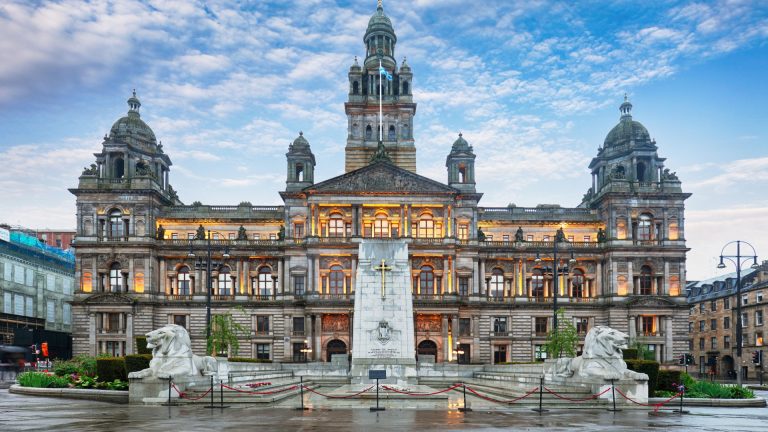
This week, Hannah, Allison, and Josh discuss Glasgow City Council’s plans to expand parking controls in the City’s Southside and East End. Aimed at curbing the effects of commuter parking in residential areas and supporting the Glasgow Transport Strategy’s goal of a 30% reduction in vehicle kilometres by 2030, the plans have faced criticism from both businesses and residents. Hannah, Allison, and Josh discuss the design of the proposals, expected economic and environmental impacts, and evidence provided by Glasgow City Council.
Timestamps
(00:00) – Introduction
(03:22) – Rationale for the Policy
(04:40) – Glasgow City Council’s Evidence
(06:45) – Emissions & Air Quality
(10:23) – Piecemeal Approach to Implementation
(11:37) – Concerns of Businesses & Residents
(16:19) – Using Revenue Raised
Transcript
Hannah (00:05)
Welcome back to our latest Fraser of Allander podcast. I’m Hannah Randolph, an economist here at the Fraser of Allander. And today I’m joined by my colleagues Josh Hampson and Alison Catalano to talk about a proposal to introduce new parking charges in some neighbourhoods around Glasgow.
These neighbourhoods are in the east end and south side of the city and are somewhat similar to existing schemes in the west end and city centre. Recently, the existing schemes changed to charging an annual fee for resident parking permits based on average vehicle emissions rather than on the zone where the parking is.
So Josh, can you tell us a bit more about the proposals for the new neighbourhood?
Josh (00:40)
Yeah, so as you said, proposals are quite similar to the existing schemes in West End and the city centre. The general rule would be no waiting at any time. You can’t even stop the vehicle in these areas except in March. So the council would be parking based on the streets. They would be charged at £1.20 per 15 minutes, so £4.80 an hour with a maximum stay of three hours and would operate from 8am until 10pm, 7 days a week.
So outside of those times the no waiting any time rule is still enforced, but the marked bays themselves are no longer charged on pain display. With the residential permits, as of August this year 2025, the City Council changed how those permits are charged previously. It would be an annual fee which can also be paid quarterly.
Based on the zones, city central was obviously more expensive than what West End zones were. Now it moves towards the vehicle emissions and the grams of carbon dioxide produced per kilometre driven is now the basis for what tariff for the permit gets charged to the resident. You have to prove the vehicle is registered to an address within the and the range and price. The cheapest price is £80 a year. The highest is now £220 a year based on the emissions and for additional vehicles, it’s 125 for the second for the household, 250 for the third and 375 for the fourth to have additional ones and that’s irrespective of emissions.
The permits are issued virtually and any new builds that are done in the areas after the enforcement comes in are not eligible for residential permits either. Most of them tend to have car parks. These are sort of higher density areas, four five story, if not six story buildings, tenements and all that. They’re all flats. so having designated parking built into the new ones is there.
There’s maybe a small thing to mention as well. So HMOs, are regulated houses and multi-occupant areas are regulated flats and have higher fire safety standards. Most of the time they’re occupied by students almost all with rental flats. These would be limited to one permit only. That’s likely there as a way to stop you having a flat. If it wasn’t, the HMO would be occupied by one family instead of being occupied by three or four students. Having three or four cars associated to ⁓ it, is another issue there with a lot of students won’t have their vehicle registered to their HMO either because it would likely be issue with their parents and so they just won’t be able to park in these areas under residential permits.
Hannah (03:15)
What is the scheme intended to do? So is this about changing people’s behaviour? Is this about raising revenue for the council?
Josh (03:22)
Yes, it’s about changing behaviour. So the Glasgow Transport Strategy directs transport policies in Glasgow up to 2030 and one of the key targets there is reducing car kilometres by 30%. So third of current car driving will want to be replaced with walking, cycling and public transport. We also want to promote more liveable neighbourhoods, improve public services, as well as giving residents priority within residential areas. So the key here is about changing behaviour to discourage people to drive by making parking and storing of the vehicles more difficult. There is of course a economic argument that free parking in a dense area is a social cost and schemes like this then internalise that into the private cost of driving.
Another issue that’s been brought up specifically in some of these areas is also commuter parking because there’s charges in the city centre and the West End. It’s not uncommon for areas in the East End and the South Side to have lots of people drive in park and then use the train lines to get in and out of the city, even if it’s just a couple of stops on each train mine or in some cases just park in the east end and walk along into the city centre.
Hannah (04:27)
And the council had put out some evidence about kind of the scale of that commuter problem, right? And so you had some examples, you know, what evidence do we have that that parking charges are needed or might help with that kind of problem?
Josh (04:40)
I don’t think the council helps themselves with the robustness of evidence that they use. One example of the draft report for the report of Dennistoun, they carried out a traffic study, the way you tend to do these things is you do one period at night time, so between two and four, but there’s going to be no congestion on the roads. And then you do one at the equivalent time during the day to see how busy is it, what’s the additional number of cars. This is the way you measure the impact of congestion on average speed. You do it basically at midnight and then at midday to see how quickly you drive or how far you drive in an hour. So their survey in Dennistoun. Their overnight study counts 2622 vehicles apart, which would suggest that’s how many residents are parking in the Dennistoun.
Their daytime findings are 2681. That would suggest the net impact of commuting driving in Dennistoun as about 40 extra vehicles. That doesn’t mean there’s only 40 commuters because of course during the day time we’ll have residents commuting out of Dennistoun and then being replaced by non-residents commuting in and vice versa in the evening. They’ve done this on a Friday so that daytime period is 2 to 4 on a Friday afternoon which particularly post pandemic flexible working that’s maybe not the best indication of severe commuter parking is.
There are also some examples on the council’s website of positive examples of parking controls and areas that they already exist. And these are before and after photos. They’re not timestamped. They are taken from seemingly roughly the same point in streets, but they’re just random streets in these areas showing before and after photos of the cars. So again, it’s the level of robustness with the evidence that I think that then opens up a lot of the criticism that’s being seen towards each proposal.
Hannah (06:22)
Okay. So is it fair to say that we don’t have, we just don’t have a ton of evidence about whether or not this kind of thing would help?
Josh (06:30)
Yeah, think that’s the case. Certainly, I think there’s an acceptance that there are issues with parking in Glasgow, but the actual quantity of evidence that you would expect to be robust to support policy like this doesn’t underpin it to the extent that we’d like to see it.
Hannah (06:45)
And one of the purposes of the scheme is to reduce emissions. I mean, that’s the whole point of, you know, reducing miles driven or kilometres driven. So, Allison, what does air quality currently look like around Glasgow? And does this kind of scheme seem like it would be helpful in improving air quality?
Allison (07:03)
So there’s a couple things that you don’t want to consider when you’re looking at transport emissions and pollution concentrations. A lot of times these policies will, things like the LEZ, parking issues like this will target CO2, the carbon dioxide, and incidentally will also target nitrogen dioxide, particulate matter, and other pollutant concentrations.
Carbon dioxide is important to consider because obviously that’s going to accelerate climate change with things like particulate matter and nitrogen dioxide and nitrogen oxides more generally. Those are going to have really direct health impacts. So those are things that I kind of tend to look at. from a health and equality perspective, those two pollutants also they’re a little bit less, you know, carbon dioxide. I think sort of moves around a bit more and those two tend to stay a little bit more concentrated in their areas.
With those two, the areas that are the most polluted in Glasgow tend to be these big transport corridors just north of Dennistoun and in the southwest, kind of just outside of like, I think it’s a Strathbungo, that sort of area. When we look at things like the LEZ, what that did was that lowered nitrogen dioxide and particulate matter pretty equally for the whole city, which is a good thing. That’s what we want to see. With policies like this, you want to see something like that. You want to see that it will improve air quality equally throughout.
What we worry about is that it will move pollution to more deprived areas. So areas like Dennistoun tend to be really non-deprived, tend to be quite wealthy. Again, they do have some of the worst air quality in Glasgow, again, lowering air pollution concentrations there, net good for the city as a whole. But you also want to see that it’s not moving air pollution into more deprived areas. And again, in Dennistoun, ⁓ to the west, you’ll have the city centre. You’re not going to get displacement effect; traffic is not going to move from Dennistoun into the city centre. Where it would move is probably the neighbourhoods immediately to the east, which is Hag Hill, or immediately to the south, which is like the Bridgeton area.
And both of those are very severely deprived parts of the city. So when we’re lowering emissions, we’re lowering them equally for everyone, but that’s not necessarily an equitable outcome. Some areas need it to be lowered more because they experience it more. And in deprived areas, the effects, the health effects of these pollutant concentrations are necessarily going to be worse because of other factors in people living in deprived areas’ lives.
So what you would hope is that some of these targeted policies address areas that will have more severe health outcomes more. Again, we’ll probably see a net. If this is effective in lowering air pollution overall, just by making it more annoying to drive into these areas, we would probably see air pollution in Haghill go down. What we would want to see is that it goes down more than it goes down in other areas because of the relative inequality that people living in area faces. And so there’s this worry that that’s not what’s going to happen. And then in fact, there might be a little bit of a pickup because they might be seeing traffic in their areas.
Again, we don’t really know what’s going to happen, but that’s kind of from a health perspective, that’s the concern that we’re facing.
Hannah (10:23)
Yeah, I’m struck by the idea of, you know, you can displace commuters and certainly there’s fairly frequent rail services between some of the neighbourhoods that you’ve mentioned and the city centre. And so people kind of end up going there to park instead of coming into Dennistoun or Strathbungo and then take the train in. But that could potentially increase some of the traffic in those areas and that could be a concern. Is there any kind of prospect of more unified citywide approach as opposed to this kind of neighbourhood introduction.
Josh (11:00)
They tend to be doing it neighbourhood by neighbourhood. So there’s a series of them that are currently under consideration for introduction in some point in 2025, 26. So it’ll be 26. So Battlefield, which is south side, Broomhill and Thornwood, which is slightly to the west, Denison, which is east, and then Shawlands and Strathbungo, which is also in the south. And then there’s a list of other areas that they have acknowledged they’re going to be looking for proposals for in 26, 27, but haven’t quite gotten to doing that yet.
I think they are moving towards doing it across the city, but it’s not going to be a blanket introduction across every area in the city. It’s sort of being done piecemeal by neighbourhood.
Hannah (11:37)
And so a fair amount of attention has been brought to this by businesses who are concerned about reduced footfall. And there’s also potentially going to be pushback from residents. So the example that you talked about before was Dennistoun, where the proposal would essentially have enough parking spaces for everyone who lives in Dennistoun. So it’s less about ensuring that the parking is available and more about that people would now have to pay this charge. So potentially some pushback from businesses and from households. Do you think that the scheme is sort well designed from that respect? ⁓
Josh (12:13)
I’ll talk about the residential one first and then I’ll come on to the businesses. So two slightly different things.
Going back to the Dennistoun one, again, the survey that’s been done by the council would indicate 2,600 vehicles. The plans for a number of marked bays in Dennistoun is 3,000. And so that would suggest that there’s an abundance of spaces and that you could effectively give every resident in Dennistoun that currently parks there a marked bay for free. wouldn’t necessarily be right outside the flat, but that sort of then weakens the justification for the policy of vote what is it you’re intervening to deal with here.
The parking problems that are widely recognised tend to be what you might call inconsiderate anti-social parking. People parking on pavements, people parking in junctions, people would effectively just abandoning cars.
And what might be going on here is that with the enforcement of the marked bays, because you’re not allowed to park out of them at that cracks down on the inconsiderate parking, which is happening at the same time that the pay & display rates are being introduced. And that’s sort of what you’re going on there is that the policy is designed to prevent, to extend prevent message from driving as well by introducing costs on the parking. the biggest thing that actually ends up targeting and improving is the sort of inconsiderate parking.
In that regard, it will tackle the inconsiderate parking, but is it well designed overall?, particularly with the how expensive the permits now are. The emissions from an average vehicle will mean that the average vehicle owner will now be paying £150 a year for a residential permit. So that’s something that needs to be reconciled about are the charges well designed and are they maybe a little too heavy handed.
There’s also been criticism about a one size fits all approach and this comes from businesses. The business permit is much more expensive than the residential permit as well. It’s £1,050 a year and that’s transferable between vehicles so that the business can use it there. There have been concerns about businesses seeing a reduction in their footfall. The Federation of Small Businesses has a fear that some businesses may, some businesses are predicting up to 30 % reduction from modelling. Again, do think this comes back to the evidence that seems to be strategically worded that it says some businesses who are predicting 30 % footfall, no. It doesn’t really present at the average.
Yes, I understand the concern of businesses. Businesses also tend to overestimate car-dependent customers, particularly in sort of mixed-use areas like Shawlands, like Strathbungo, like Dennistoun, an example from Bristol, a survey that was done is that 41 % of businesses estimated that 41 % of the customers drove to the shop. That was actually 22%. And this is something you see across the board. Businesses almost always overestimate car usage by their customers, mainly because car usage is more visible than people that walk. If you’re a restaurant, you’re taking calls and people phone up and go hi, is there parking that sticks out in your mind simply more than someone just phoning up to book and not necessarily asking about parking.
So when you look at the West End and the city centre, the businesses and areas have still thrived even with the permit, even with the charges being introduced. I can understand the concern of them, but they’re likely more worried about it than they need to be.
The overall design of it, the one size fits all approach does seem to be a bit problematic. The idea that the residential permits in the city centre would be the same as they are in South Side, East End, or West End suburbs. I feel like that’s a little too heavy handed to have such expensive residential permits.
Nevertheless, do see examples of residents appreciating in these areas the policies after they’ve been introduced. It’s similar to what you see with a lot of transport policy. The idea of the policy or the idea of the change is often worse and elicits a worse reaction, the change itself, that doesn’t mean there haven’t been very vocal oppositions. Businesses in the South Side have been mocking proposals on social media quite successfully. One I saw was over 75,000 views on TikTok and there’s currently an open letter from the Southside with over 6,500 signatures. It’s clear people do disagree with the design of the proposals as they currently exist.
Hannah (16:19)
And this money is the money any revenue that comes from the policy is required to be spent on transport.
Josh (16:27)
Yes, the council, any revenues raised, the council will have to spend on transport and the extent to which residents feel that is being effectively spent, quality upgrades to transport remains to be seen.
Hannah (16:38)
So, if you could tie it more closely to certain transport improvements that might go in or be made or to greater enforcement of some of the antisocial parking, then that might help to support a bit for the policy.
Josh (16:53)
Yeah, generally you’d expect that. Obviously, people don’t like paying for things and don’t like paying for taxes, but if you can see that you’re getting quality services and return for those taxes, people are more willing to accept it. That sort of the issue is, I think people are worried that this approach is all stuck in no carrot and sort of what’s the encouragement being done at time, pushing charges on people, but to discourage them from driving, where’s the encouragement to use other modes?
Will this be using bus services or train services? The extent to which Glasgow City Council as it currently exists or directly controls and influences policies? Also limits its ability to spend on those things.
Allison (17:32)
I suppose that might be why it’s so annoying in the Southside and Dennistoun compared to the city centre, right? Where transport links are significantly weaker. And I guess from a business perspective, one thing that hasn’t really come up, you know, lot of these are hospitality businesses tend to be open a little bit later past when transport links are viable.
So we know that there’s a big issue in hospitality from some other work that we did at the Fraser in the past few years, the Serving the Future project, where you know, getting employees home safely is a real valid concern for people working in those sectors and without adequate transport links and also without feasible parking. How do you do that without it being unjustly expensive and or forcing those employees to park in again these displacement areas which tend to be a little bit more deprived and tend to be a little bit outside of those neighbourhoods.
Josh (18:23)
I think that’s a great point and so class time with hospitality staff is okay if your shift starts in the evening, you may be fine to get transport to the job in the first place but if you’re not finishing your shift until midnight or just after you need the car to drive home. If you can’t get the car in the first place at the of the shift, you’re sort of in the process of trying to organise lifts for people or having people drive in to then drive out. You’re just not having them parked there.
There’s also be a point to maintain the reaction from businesses and these are sort of fixed businesses in the area but there’s also an issue with non-fixed efficiency basically tradesmen and services are done by van of where do they park? You can apply to the city council for a parking dispensation. They have the policy that no parking should be free and so you’d have to pay for something, but it may allow a van if there’s work going on to park for longer, but that’s also complicated process in itself just to go through to apply for that.
Residential visiting passes exist. So these are sold at five pound for a set six hour period, but it’s a set of six hours. If the workmen you have in needs longer than three hours, which they’d be paying on the street for, they need to effectively schedule with their time. So, I think that’s almost an equity thing there where it’s the impact of this will be more severe on certain types of workers and it will be on others.
Hannah (19:34)
All right. Thank you for joining me today, Josh and Allison. We’ll be following these proposals in the new year, and you can find our other podcast episodes about Glasgow transport on our website, fraserofallander.org. And if you’ve been listening and you live in some of these neighbourhoods, you should keep an eye out for active consultations on these proposals. Stay tuned for our lead-in and reactions to the Scottish budget in January as well. Thank you for listening. Until the new year, we’ll see you then.
Authors

Hannah is a Fellow at the Fraser of Allander Institute. She specialises in applied social policy analysis with a focus on social security, poverty and inequality, labour supply, and immigration.

Allison is a Fellow at the Fraser of Allander Institute. She specialises in socioeconomic inequality, labour market dynamics, and the socioeconomic determinants of health.

Josh is a Knowledge Exchange Assistant at the Fraser of Allander Institute, at the University of Strathclyde.