

On the 1st of April 2026, the University of Strathclyde’s Learning Disabilities Research Network held their second event. This event brought together network members and organisations who support people with learning disabilities for a collaborative workshop titled ‘Belonging Through Good Work’.
The workshop asked three key questions: where are we now in terms of employment for people with learning disabilities; what does a good future include; and how do we get there?
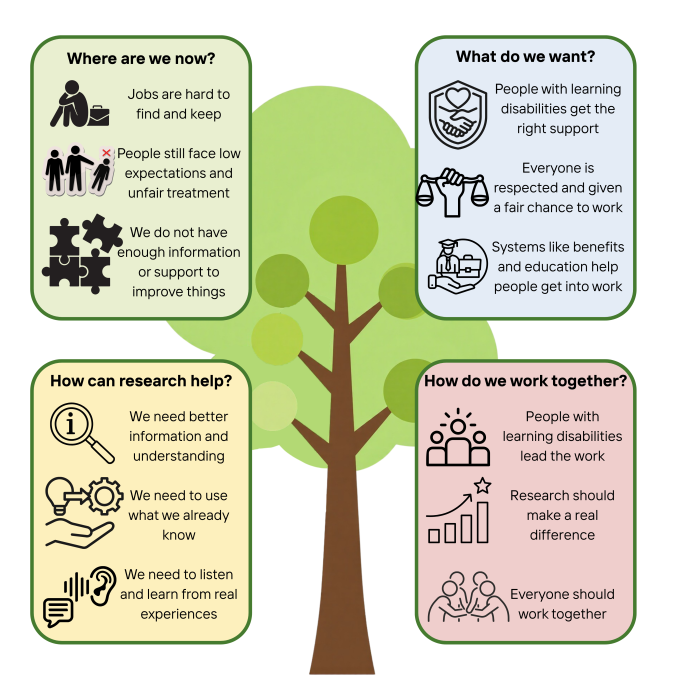
This blog summarises the findings of the workshop. We have also included a graphic above summarising the findings.
Where are we now?
Participants shared their experiences to highlight issues in the current landscape for people with learning disabilities who want to work. We have grouped these into some key themes below.
Employment is limited and fragile
Organisations told us that employment opportunities for people with learning disabilities are few and far between, and when available are small-scale, time-limited, precarious, and with no room for progression. Participants discussed the prevalence of unpaid volunteering roles, which can act as a stepping stone to paid work, but in reality often leave people stuck. In other cases, unpaid work is not financially feasible: one example provided by an organisation was that supported internships which count as full-time study make individuals ineligible for Universal Credit. Inaccessible recruitment processes contribute to limited opportunities for employment significantly, as well as gaps between what employers say and what they do.
Organisations reflected that if individuals do achieve a paid role, support is limited and frequently ends once the person is ‘settled’. Overall, participants agreed that the current system isn’t designed for long-term inclusion.
Low expectations and discrimination remain widespread
Participants consistently described low aspirations in education, employment services, and among employers. There is still significant discrimination specifically against people with learning disabilities, including tacit “triage” about who is seen as an acceptable employee. Segregated education continues to reinforce this, alongside the prevalence of the medical model of disability, and ableism embedded in research and systems.
Lack of resources and data are driving an implementation gap
Organisations reported that there has been a long‑term erosion of practical, work‑based training projects over the last 20 years. Participants felt that policy ambition has increased, but implementation has weakened, making things feel harder rather than easier. The voluntary sector provides significant support for people with learning disabilities who want to access work, but this is overly dependent on short‑term and precarious funding.
At the same time, participants stressed the need to understand the whole‑life impact of employment: confidence, independence, health, social connection, and family wellbeing. There is insufficient data on where individuals who have taken part in employability programmes end up, whether people stay employed, and what difference employment makes over time. This topic was a key focus in our Learning Disabilities Research Symposium last year.
What does a good future look like?
After discussing the present, we asked participants to think about the future. We thought about the future in terms of statements that must be true for people with learning disabilities to achieve good work. We had a wide range of statements, covering everything from benefits to accessible transport. Below, we have summarised the ideas into three key statements for the future.
1. People with learning disabilities are adequately supported
All employers – public, private, and third sector – work to the same inclusive standards. Managers are trained to adapt work, lead inclusively, and support diverse colleagues. Flexibility and responsiveness are normal practice, not exceptions. Work buddies, inclusive management, and well‑trained teams are standard.
Support is available at the right time, for as long as it is needed, not tied to short programmes or funding cycles. People are supported across their whole career – including progression, changes, setbacks, and transitions. Employers can trust support services because funding is long‑term, consistent, and reliable.
2. Our culture enables good work for all
In this future, our culture enables good work for everyone by embedding accessibility from the outset – not as an add-on. Universal design shapes roles, recruitment, workplaces, technology, training and information, with clear, accessible formats like Easy Read as standard. Digital tools, alongside human support, expand access rather than create barriers. As a result, finding and sustaining paid work is simple, accessible and personalised. Skills-based matching connects people to roles based on strengths, preferences and potential, while work trials and reasonable adjustments are routine – ensuring everyone has a fair opportunity to thrive.
A shared understanding of learning disability underpins this, with lived experience leading awareness and assumptions continually challenged. Stigma and low expectations, both in education and work, are replaced by respect, confidence and ambition.
3. Wider systems support people into work
Participants agreed that wider systems must support people with learning disabilities into work, rather than fight against this goal, if we are to achieve good work for all. This includes the benefits system functioning as a flexible, reliable safety net, designed to support people with learning disabilities to work without fear of losing financial security, this requires better connection between social security and employability services. It includes places of education such as schools valuing value non‑academic skills, adopting strengths‑ and skills‑based approaches, and actively supporting transitions into work. And it includes infrastructure such as public transport being reliable and accessible. A key idea that came out of the workshop was that people should have choice and control.
Employment is seen as part of an inclusive society, not an isolated intervention. Overall, policy intent and practice are fully aligned.
How do we get there?
We asked those at the event how research could help to bridge the gap between the present and the future described above.
Organisations agreed that we lack a strong, joined-up evidence base. We need better basic data on long-term outcomes, but also more information on how wider systems (like benefits and future labour markets) shape people’s lives. Lack of data limits understanding, accountability and strategic thinking.
At the same time, participants noted that the evidence we collect is not consistently translated into practice, scaled, or used to influence funding and delivery. For some topics e.g. ‘what works’ when it comes to supporting people with learning disabilities into work, the challenge is less about discovering new ideas and more about effectively applying what we already know.
Finally, there was a joint understanding that research needs to better reflect real-world perspectives. People with learning disabilities, employers, and education systems need to be included in all research to understand behaviour, shape inclusive environments, and drive meaningful change.
Principles, partnerships and next steps
Lastly, we discussed how research should be done, including the principles that should guide inclusive research and how partnerships should work so that everyone involved benefits.
Participants concluded that research in this area requires strong, inclusive partnerships across the whole system. Co-production and collaboration with people with learning disabilities and those who support them should be standard practice, ensuring shared ownership, wider insight, and greater impact.
Our next steps as a network will be discussing ideas raised so far with a larger group of individuals with lived experience of learning disabilities. We will be visiting various groups and organisations to hear from as many people as we can over the coming months.
We would like to thank all participants who attended the workshop. If this work is of interest to you and you haven’t yet taken part, please get in touch – we would love to speak with you.
With thanks to network members Andrea Tonner, Marisa Smith, David Jack, Brodie Gillan, Jane Essex, and Angie Black who supported the event.
Authors

Chirsty is a Knowledge Exchange Associate at the Fraser of Allander Institute where she primarily works on projects related to employment and inequality.