

Scotland is at a turning point in how health and care data is managed. Initiatives like the National Digital Platform (NDP) from NHS Education for Scotland (NES), the Digital Front Door, and efforts to integrate health and social care records all point to a future where individuals have more control. The recent announcement of MyCare.scot — the first step in the Digital Front Door — makes clear that this future is already taking shape, with rollout planned from April 2026 following a pilot in Lanarkshire. But for people with learning disabilities, digital transformation too often feels like something happening to them, not with them.
That’s why the Fraser of Allander Institute (FAI), alongside the Scottish Commission for People with Learning Disabilities (SCLD) and PAMIS, has been exploring the potential of Personal Data Stores (PDS)—ably supported by the Digital Health & Care Innovation Centre (DHI), who have been leading workshops and participatory design activities for us.
This project began as part of the FAI’s second research programme on the lives of people with learning disabilities, which focused on strengthening the evidence base and improving employment outcomes for people with learning disabilities in Scotland. While our earlier research highlighted barriers and inequalities, this programme was oriented towards identifying practical solutions and generating actionable insights that could support positive change. The aim of this collaborative project was to explore how data, technology, and person-centred approaches could both support individuals directly and help strengthen the evidence base, with a view to closing gaps in understanding and informing future policies and services that are more inclusive, effective, and responsive to individual needs.
The project was also a direct response to an SCLD report published at the end of 2023, funded by the Scottish Government’s Technology Enabled Care team. The report set out recommendations to strengthen digital inclusion and promote digital solutions for people with learning disabilities in the short to medium term. One of these recommendations was for a co-produced “learning disability pathfinder” project using PDS, designed to help people engage more confidently with health and social care services.
Personal Data Stores
A personal data store (or person-owned records) allows people to securely hold, manage, and share their own data. Unlike traditional systems, where information about a person is fragmented across multiple organisations, a PDS puts the person at the centre. They decide what gets shared, with whom, and for what purpose.
For people with learning disabilities and other vulnerable groups, this can be particularly powerful: it means they can tell their story once and have it stored safely, then choose when, how, and with whom to share it. Furthermore, when the information is stored as structured data this means it can be shared automatically according to rules set by the person. Structured data means the person’s PDS can share data with other digital systems. This could reduce repetitive questioning, capture personal communication styles and preferences, and support more coordinated, responsive care.
Personal data stores also present opportunities for the collection and integration of qualitative insights—such as self-reported experiences, personal narratives, and feedback—directly from individuals, with their consent. This provides essential context to quantitative data, particularly in understanding how people experience health and care systems and the lived experience of social determinants. Insights from people engaging with multiple services can illuminate how socioeconomic factors like housing, employment, and education intersect with health outcomes. This person-centred evidence can help address gaps in traditional surveys or administrative sources, which in many cases are constrained by declining response rates and data that quickly becomes outdated.
There are, of course, challenges. PDS data may be less consistently structured than traditional datasets, making harmonisation and analysis more complex. Ensuring robust governance, data standards, and interoperability is essential, alongside maintaining trust through transparent, ethical data use. If these challenges are managed effectively, PDS could complement other data sources, supporting more inclusive, person-centred policy development and ultimately contributing to a better understanding—and reduction—of health inequalities in Scotland.
Pilot projects in Scotland are exploring PDS use with vulnerable groups, including people receiving cancer care and those living with frailty or dementia, highlighting both the capability and the real-world considerations of this approach. The challenge—and the opportunity—lies in turning this potential into practical solutions that support individuals while strengthening the evidence base to better inform policy, service design, research, and practice, and to drive the continuous improvement of systems and services across sectors.
Organisation-centred vs person-centred data stores
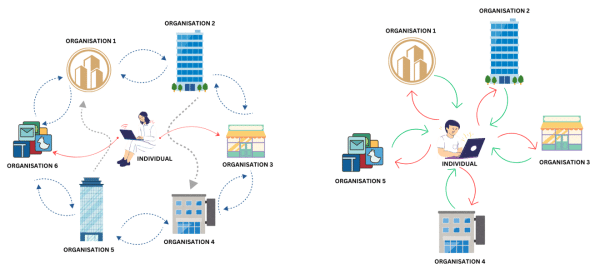
Source: Adapted from Hill, S. (2020)
The graphic above show organisation-centred data storage model (left) vs. user-centred storage model (right). Personal data stores (PDS) are a type of the latter. While the first model allows sharing of information among various organisations, in the user-centric model information only flows between the user and the organisation.
Building on the Person-Centred Approach of the PAMIS Digital Passport
Between May 2024 and June 2025, DHI and partners explored how personal data stores could support people with learning disabilities through a participatory design process. This collaborative approach involves designing with users, not for them, ensuring solutions reflect real needs, preferences, and lived experience— particularly for groups often overlooked in decision-making, such as people with learning disabilities. The idea is that, if a person is to use a future service (or have that future service used on their behalf) then they, or their peers, should have a meaningful contribution to the design of that service. Two workshops brought together professionals, carers, and members of the SCLD Digital Navigator Board—people with lived experience shaping their own digital futures.
To ground the conversation in something tangible, we started with a tool already in use: the PAMIS Digital Passport, a multimedia record developed to support people with profound and multiple learning disabilities (PMLD). The Passport is a striking example of person-centred design in action. It captures more than just health or social care needs, representing the individual’s personality, preferences, aspirations, and ways of communicating. This holistic view helps carers, professionals, and services understand the person fully, enabling support that is tailored, effective, and centred on the individual’s personal context.
Experience shows that when practitioners engage with the Passport, they often gain a much richer understanding of the individual, which directly informs how they plan and deliver support. It demonstrates that to achieve the best outcomes, it’s not enough to focus narrowly on clinical needs—engaging with the person’s preferences, motivations, and everyday experiences is essential.
A key insight from the Passport is the value of “telling your story once.” By capturing personal histories, communication styles, and preferences in one secure place, individuals can choose when, how, and with whom to share their information—reducing repetition, improving coordination, and giving them greater control.
The workshops were designed to learn from the PAMIS Digital Passport. By starting with a proven example, we were able to explore how technology could support person-centred approaches, strengthen the evidence base, improve coordination across services, and enable continuous improvement.
Insights and emerging principles from the participatory design workshops
The participatory design process highlighted the importance of balancing two needs:
- The structured data needed for service integration, with select elements usable for research and/or analysis, and
- The expressive, multimedia elements that capture the human story and what matters to the person.
There is a fine balance to be struck between these two needs. People want to be expressive and describe themselves in their own way. Yet, without structuring the data, people’s information can be excluded from many existing systems and services. The workshops suggested a number of features and considerations that could guide future development of person-centred digital tools:
- Keep it relevant – the ability to skip or hide sections that don’t apply, with prompts to highlight what might be useful.
- Support personal expression – space for people to decide what matters most and organise their information alongside structured data.
- Make it multimedia – using text, image, audio, and video to allow different ways of communicating.
- Be transparent – showing who added information and when, with version history where helpful.
- Think national, not local – ensuring consistency across Scotland, avoiding tools tied to a single health board or system, while keeping ownership entirely with the individual.
- Enable smart sharing – options to share just the right subset of data, digitally or on paper.
- Keep it searchable – making information quick and easy to find.
- Show the journey – offering a timeline view so changes over time can be seen.
- Adapt to context – tailoring what information is shown for emergencies, appointments, or everyday support.
These principles don’t define a single tool—they illustrate what people valued when considering a more citizen-centred approach to data in Scotland.
Looking ahead
Building on insights from Stage 1, partners are exploring a potential next phase: testing a practical use case for people with learning disabilities. This aligns with DHI’s ongoing pathfinder projects, which aim to understand and de-risk complex, front-line care requirements as part of Scotland’s Digital Front Door ambitions.
Future work would continue to consider potential integration with NHS and social care electronic records, particularly the National Digital Platform (NDP), which represents the near-future standard for record-keeping across Scotland.
One approach is to identify an existing platform that could be developed and configured to deliver digital passport capability as a modular feature alongside other use cases—such as falls prevention or healthy living. The Community Connections platform is well-suited for this purpose and offers the opportunity to develop a module focused on complex care needs.
Community Connections provides a person-owned record and is currently being tested in Moray as part of DHI’s Rural Centre of Excellence work. While the platform is primarily focused on health and care innovation, it could also store information beyond these services. Taking the learnings from the first phase, Stage 2 could explore ways to enhance the platform’s flexibility—including multimedia capabilities and delegated access—to better support people with complex care needs, such as those with learning disabilities.
The module could also include a self-referral process for Annual Health Checks for people with learning disabilities as part of this use case. This would allow participants to build and share their records in a structured, person-centred way, reducing duplication, improving care coordination, and retaining the holistic, personal elements that matter most—such as personal expression, choice, and engagement.
Towards Inclusive, Person-Centred Data
Whilst this work aligns with Scotland’s digital health and care reform ambitions—empowering people to access and use their health and care data in ways that improve wellbeing, boost inclusion, and make data sharing more meaningful—personal data stores won’t solve everything overnight. Governance questions, professional adoption, and technical integration with cornerstone systems such as the NDP will all take time to work through. But the participatory design work so far has shown that people with learning disabilities, their families, and their advocates are ready to be part of the conversation—not as afterthoughts, but as co-designers.
With MyCare.scot moving from concept into implementation, there is now a window of opportunity to ensure the system truly works for everyone. Rather than developing parallel solutions in isolation, the challenge is to build in ways that reflect diverse needs. If designed well, this could help prevent repetition, centre personhood, and ensure that people with learning disabilities don’t just adapt to the system, but actively shape it.
This work is about more than technology. By focusing on a specific use case—such as improving the identification, offer, and completion rates of Annual Health Checks for people with learning disabilities (latest data showed only a 24% offer rate for 2024/25)—we can explore what’s possible, test what works, and learn quickly. Ultimately, this approach can help ensure that the lives and experiences of people with learning disabilities are better represented, transforming how data informs policy, practice, and services across Scotland.
Read the full report on how DHI’s co-design with people with learning disabilities and key stakeholders is shaping Scotland’s vision for person-centred data — click here.
Authors

David is a Senior Knowledge Exchange Fellow at the Fraser of Allander Institute. Previously, he worked in a range of analytical positions across the public sector, primarily as a statistician.